

Learning to trust – one paw at a time
By Katherine Granich
Canine Comprehension is the Melbourne organisation using animal-assisted learning to help children find their feet – in school and in life.
Ten years ago, when Sarah Macdonald introduced her Doberman Ridgeback, Minnie, to a classroom of kids, she didn’t know she was about to start a business. She just knew that Minnie – emotionally intelligent, deeply sensitive, and occasionally freaked out by loud noises – had a way of reaching children that nothing else quite could.
“She would just know to creep up to the right person,” Sarah says. “But she could be fearful. So sometimes we’d go into a noisy classroom, and she’d dive under a chair.” Sarah would turn the moment into a lesson, saying to the children, “This is how Minnie is feeling right now. What can we do to make her realise you’re safe?” The children, who had plenty of their own issues and challenges, would tune right in – and that’s when the real work would begin.
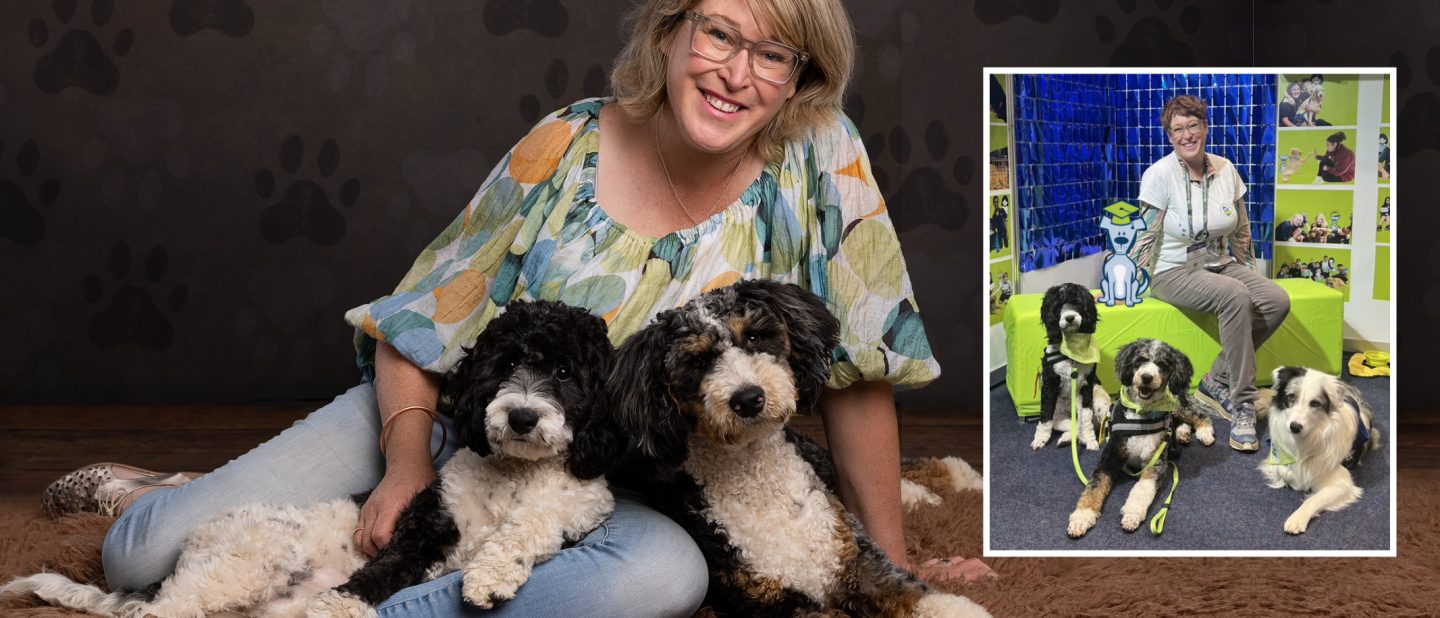
That insight is at the heart of Canine Comprehension, the Melbourne-based animal-assisted learning organisation Sarah founded over a decade ago. What began with Sarah, Minnie, and another pet “co-worker” named Oscar has grown into a team of 20 people – including 16 mentors, each a qualified professional in education, allied health, or social work, who also hold Animal Assisted Therapy certification. Together with approximately 20 working therapy dogs, they visit around 35 schools per term across Victoria. The dogs have their own profiles on the Canine Comprehension website, of course.
Canine Comprehension’s programs are not “therapy” in the clinical sense. Sarah describes what the dogs offer as Animal Assisted Learning, and the focus is on school readiness: Building the emotional regulation, social skills, and wellbeing that, together, allows children to show up and engage.
Programs are carefully tailored to what each school and each child needs. Sessions with special development schools, for example, look somewhat different to those in a mainstream setting. For example, a large group of children might work with a dog-and-mentor team, or they might run individual 10-minute sessions with several children in rotation, or a longer session with a small group of four children. “We sit down with the school,” Sarah says. “We ask where their kids are at, and we work out what’s going to work for them, and build their program to suit.”
In special development schools, where children are often working at their own pace and in their own world, even getting a small group to acknowledge each other can feel like a win. One of the activities Sarah describes involves attaching three leads to the same dog, and handing one lead to each child. If they pull in different directions, the dog stops. To move forward, they have to work it out together – watch each other, negotiate, find a rhythm. “When the teachers notice what’s happening with the students, they’re often so surprised they stop in their tracks,” Sarah says, smiling. For the children, it’s the kind of spontaneous teamwork that doesn’t happen on demand, but somehow happens around a dog.
Another thing Sarah describes is the way a dog changes the physical dynamic of a session. When the dog is on the floor, everyone gets on the floor – not to get down to the child’s level, but simply because that’s where the dog is. It matters more than it sounds. When a mentor sits with a child directly, there’s an implicit expectation of back-and-forth, a demand on the child to engage, respond, and even perform. The presence of the dog removes that pressure entirely, because suddenly everyone’s attention shifts to a third point. “We’re all focused on the dog,” Sarah says, “and that breaks down the expectation of ‘I’m speaking to you and waiting for a response’.” For children who find direct interaction overwhelming, replacing that two-way demand with a shared focus on something else entirely can make all the difference.

Canine Comprehension mentors go into every session with a lesson plan and learning outcomes, but Sarah is clear about what matters most. “The first thing is: Did the children connect? The second is: Did they have fun? The third is: Did they do whatever was on the lesson plan? The first two are the most important. If they didn’t connect and they didn’t have fun, we’re not doing our job.”
The dogs themselves are trained with as much care and individuality as the programs they support. Unlike more regimented service dog training, Animal Assisted Learning dogs are allowed to show their personalities and work with their quirks. “They’re not performing monkeys,” Sarah says. “They’re living beings that we observe and show empathy to. That’s the whole point.”
Canine Comprehension currently operates across Melbourne and wider Victoria. Programs are not funded through NDIS, as the focus is on learning readiness rather than therapeutic intervention. Families can self-fund, or approach community organisations to sponsor a term of eight weekly sessions. In Victoria, public schools can access funding through the Mental Health in Schools menu, and the Department of Education periodically releases animal therapies funding that schools can direct toward programs like this one. Families who homeschool are also welcome, and groups of four to five children can share sessions.
Sarah’s vision is for every school in Victoria to know what Canine Comprehension does, and to be actively choosing whether it is the right fit for their students. “It is not enough just to have good curriculum,” she says. “You need kids that are in the right place to step into it.”
The dogs, it turns out, are very good at helping them find that place.
You can find out more at caninecomprehension.com.au


