

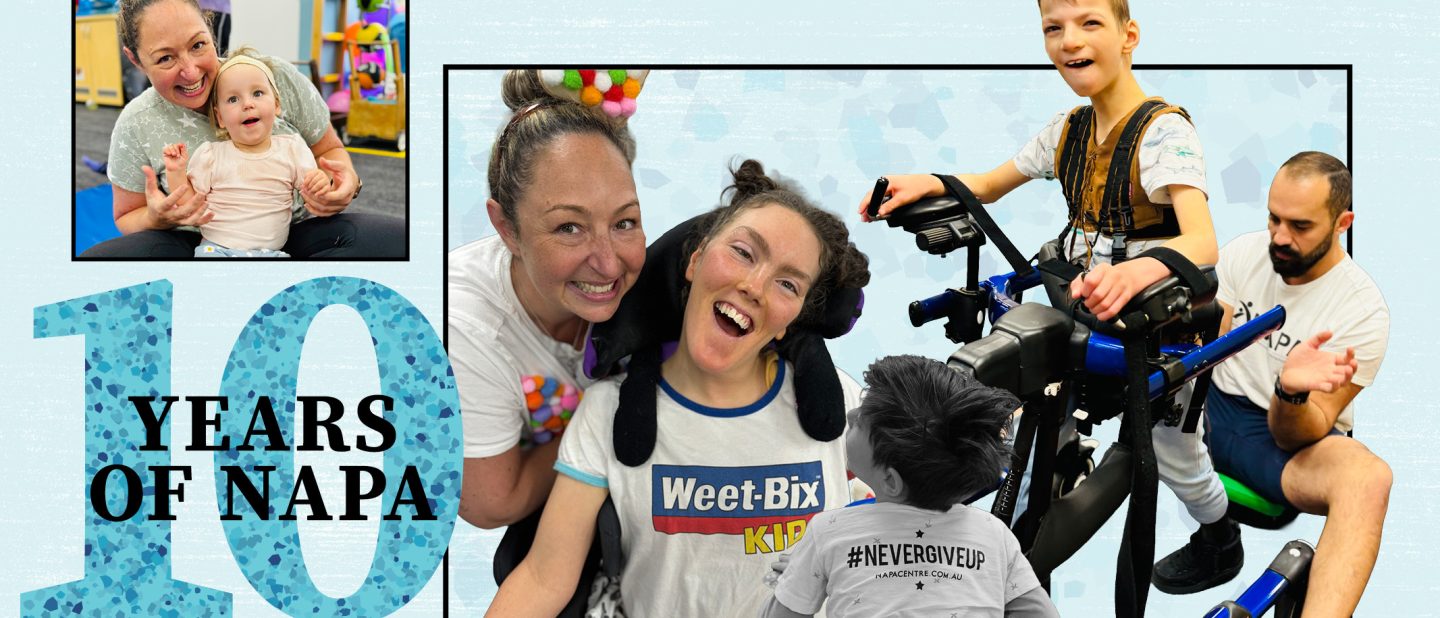
Source Q&A: 10 years of Napa Centre in Australia
Q&A with Ali Gebhardt, Occupational Therapist and Director of Clinical Operations for NAPA Australia.
Can you tell us about your role at Napa?
I’ve been a paediatric occupational therapist for 17 years, and intensive therapy at NAPA has been the most rewarding part of my career. Over my time at NAPA, I’ve helped grow all three Australian clinics and now focus on maintaining clinical excellence across our programs, training the team in the Intensive Model of Therapy (IMOT), and mentoring therapist development. I’m very privileged to work with a passionate, skilled team committed to the best outcomes for the children and families we support.
You were one of the first therapists helping to set up NAPA here in Australia. Can you tell us what those early days were like?
The early days at NAPA were a buzz of energy – lots of excitement and determination! We were introducing an intensive therapy model quite different from what many Australian clinics were used to, so there was initial hesitation from local clinicians. We felt a strong responsibility to deliver results and represent the model well.
In those first five to six months, we ran pop-up programs that showed families were seeking a more effective model of therapy for their children. It created real momentum, and we established a permanent clinic in Lane Cove, Sydney, with a small team ‒ three therapists and one admin.
Families were incredibly enthusiastic. Many had previously travelled overseas to access this level of therapy, so having it available in Australia was a big deal.
NAPA is known for its intensive therapy programs – how do they differ from traditional therapy, and why are they so effective?
What we do isn’t exactly different ‒ NAPA’s therapy is delivered by qualified physiotherapists, speech pathologists and occupational therapists. But we offer different program strategies and the ability to intensely focus on a child’s goals for maximum impact.
Typically delivered in three-week blocks, this approach harnesses neuroplasticity ‒ the brain’s ability to adapt and change. That’s where we see meaningful gains emerge, often at a pace that’s difficult to achieve with traditional weekly or fortnightly sessions. The intensive model of therapy is supported by a strong and growing body of evidence, showing that intensive, high-frequency therapy can drive meaningful functional gains by maximising neuroplasticity and skill acquisition over a shorter period of time.
NAPA also provides traditional therapy, which plays an important role in maintaining skills and supporting steady progress. But when the goal is significant change in a shorter timeframe, intensity becomes key. Repetition, consistency and daily practice allow children to build skills more effectively, while keeping sessions engaging, fun and age-appropriate.
A core strength of our approach is that no two programs are the same. Each intensive is carefully tailored to the individual child, their goals, age, diagnosis and current abilities. Programs are dynamic and responsive; we continually assess and adjust to ensure the best outcomes.
What does a typical day look like for a child on an intensive program, and how do you balance challenge, repetition, and fun?
I’m not sure there is a typical day! No two programs look the same, because each child’s intensive is tailored to their goals, abilities and needs. Generally, a child attends therapy for a recommended number of hours each day, working across a combination of disciplines ‒ physiotherapy, occupational therapy, speech pathology, feeding therapy ‒ depending on their goals. They see the same therapy team throughout the three- week block, which creates consistency, routine and strong therapeutic outcomes.
That continuity is key. It allows therapists to build on progress day by day, adjust the program in real time, and maintain clear focus on goals.
Balancing challenge, repetition and fun is where the real skill lies. Repetition is essential for learning, but it needs to be embedded in play. Instead of “doing five repetitions,” children might be rescuing animals, completing an obstacle course, or playing a game that naturally incorporates those movements or communication goals.
Ultimately, fun isn’t an add-on, it’s central to the process. When children are engaged, they learn more, retain more, and generalise those skills more effectively into everyday life.

Can you share a breakthrough moment with a child (big or small) that still stays with you?
After more than a decade at NAPA, I am so honoured to say I have seen countless breakthrough moments, which makes it almost impossible to choose just one! The moments that naturally stand out are the “firsts”: a child’s first steps, first time sitting independently, first crawl, or even the first time they can use their hands to play with a toy. These are milestones families hold on to, and they carry enormous meaning.
How has the therapy landscape changed over the past decade, and how has NAPA adapted?
Practice today looks very different to what it did ten years ago in Australia, where therapy was largely delivered in traditional weekly formats and intensive models were relatively uncommon.
At NAPA we challenged that by introducing intensive therapy as a structured, outcomes-focused approach.
Change took time, but as families and clinicians saw the gains children could achieve in a shorter timeframe, intensive therapy became more widely recognised. Multiple clinics now offer it, though NAPA remains the leader in the field.
New technologies have also transformed what’s possible. Tools like robotics, electrical stimulation, body-weight support systems and dynamic suit therapies have expanded how we support movement, strength and skill development.
Our approach is to continuously evolve ‒ exploring emerging therapies, integrating new approaches where appropriate, and refining programs based on both research and real-world results.
When you look back over the last 10 years, what makes you feel proudest about your work and the team you’ve helped build?
What stands out most is the impact. The progress children make, the skills they gain, and the confidence that builds over time. Alongside that is the sense of hope and community that has developed.
Being part of building something that creates real, meaningful change in children’s lives is incredibly rewarding.
I feel that I (and everyone at NAPA) is contributing to a global vision that has redefined what is possible in paediatric therapy.
Looking ahead, what are your hopes for the next 10 years of NAPA in Australia?
Our focus is to stay at the forefront of innovation; integrating emerging technologies, refining therapy models, and contributing to evidence-informed practice. We want to keep pushing boundaries while staying grounded in what matters most: meaningful, functional outcomes for the children we support.
Learn more about NAPA at napacentre.com.au


