Everybody in: Touch football
Touch Football Australia is making the game truly inclusive for kids with disabilities across the country, reports Katherine Granich.
Touch football might not be the first sport that comes to mind when you are looking for inclusive activity options for your child with a disability. But if Gabe Hodges has anything to do with it, that is about to change.
“It’s non-contact; you don’t have to be fast, you can walk!” grins Gabe, the National Participation Programs Manager for Touch Football Australia. “It’s just so welcoming, and everyone is so engaged.”
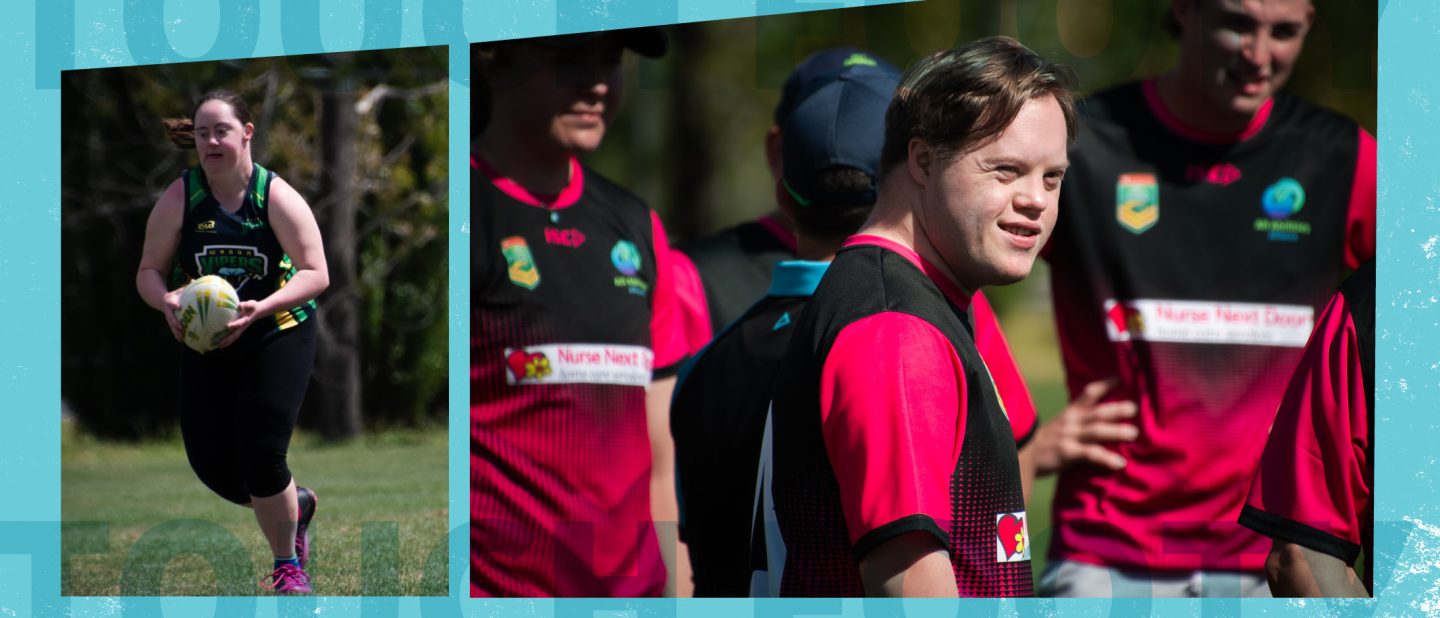
Developed in collaboration with Sport Inclusion Australia, Down Syndrome Australia, and Autism Spectrum Australia, Touch Football Australia’s All Abilities Football Program is designed to provide equal opportunities and fully integrate people with physical and intellectual disabilities into the sport. Introduced in 2019, the program has grown rapidly, with several teams across three tiers that accommodate different disability types and levels of support.
While the national All Abilities program officially launched in 2019, its foundations were laid years earlier by Gold Coast special education teacher Graeme Clancy, who started Touch Football Specialised Inc. after one of his students asked if he could play with him at the State Championships. What began as a grassroots local initiative grew into inclusive competitions and pathways for players with intellectual disabilities, supported by Sport Inclusion Australia and Queensland clubs Southern Storm and University of Queensland, both of which continue to compete annually at the Queensland State Cup.
What makes the program stand out is its commitment to genuine inclusion rather than a separate, parallel experience. All Abilities athletes play on the same fields, under the same match conditions, with the same referees, and are featured on broadcast alongside their able-bodied teammates and competitors. While modified rules allow for a maximum of three non-certified athletes to play alongside teams in a support capacity, Gabe is clear: “That’s where the differences stop.”
This commitment to inclusion is not incidental – it is central to who Touch Football Australia is. The organisation’s strategic plan is anchored by a purpose of uniting communities through safe, social, and meaningful touch football experiences, and a vision of a game that is dynamic, inclusive, and growing with every play. “Inclusion is one of our four core values,” says Gabe. “It runs through everything we do.”
From national championships to local competitions
The national championships All Abilities stream runs across three tiers depending on the type and level of disability, but the program’s reach extends well beyond the national stage. In Canberra, All Abilities players compete in standard weekly competitions alongside able-bodied players – not in a separate stream, but in the same draws. In South Australia, the program is being introduced into schools, and pockets of activity are growing in New South Wales as well.
The annual ACT All Abilities Cup, held in October in Canberra, is a highlight. “It’s my favourite event of the year,” Gabe says. “People form these big tunnels in the stadium for the Grand Final – it gives you goosebumps. I’ve got to know some of our athletes over the years, and they’ll see me on the field and run over for a high five. It is just fantastic.”
For many participants, the All Abilities Cup represents something far more significant than a day of competition. “For some of the athletes, it’s the first time they have ever competed in a big competition,” says Gabe. “And they just don’t stop smiling!” The same athletes return year after year, and Gabe has begun to recognise familiar faces from the championships – a sure sign that the program is delivering something that genuinely keeps people coming back.
More than just a game

One of the special aspects of the program is the opportunity it creates for families to play together. Because athletes with disabilities can compete alongside their siblings without disabilities in standard competitions, touch football becomes a shared family experience rather than a separate one. “They get to play in a competition together,” says Gabe. “The benefits go far beyond the field.”
The program has also opened up unexpected pathways for athletes with disabilities as referees. In Canberra, for example, several athletes with a disability have been trained to officiate, an initiative that has had some wonderful and occasionally surprising side effects. For autistic athletes in particular, the clear, rule-based structure of refereeing can be a genuine draw – and being in charge of enforcing those rules, a source of great satisfaction.
Gabe has also seen the program change lives in ways that extend well beyond the field. “We’ve had kids join the All Abilities program and find a supportive, caring niche where they can really thrive,” she says. “The confidence and sense of belonging they gain through All Abilities flows on into other parts of their lives too – school, home, friendships.” That ripple effect, she believes, is one of the program’s greatest and most underappreciated gifts.
A sport with genuine pathways
Touch Football Australia’s commitment to inclusion does not exist in isolation. A partnership with Rugby League means that clubs and programs can work hand in hand, giving players with disabilities pathways across both codes and a broader network of support. The Women’s Open captain of the Australian national team previously ran the All Abilities program nationally – a reminder that this is not a peripheral initiative, but one that sits at the heart of the sport’s culture and is championed at its highest levels.
The program also works hard to be as accessible as possible in terms of cost, with affiliates and clubs keeping fees as manageable as they can. For Gabe, the biggest barrier is simply awareness, and her advice to parents who are curious but hesitant is straightforward: Find a way to watch a game, either in person or online. “Just the joy on the athletes’ faces will sell it for you,” she says.
Getting involved
Several years on, the All Abilities program is showing no signs of slowing down. The same athletes return year after year, the smiles get bigger, and the Grand Final tunnels keep growing. “It is, without doubt, one of the best initiatives the sport has implemented across Touch Football Australia’s 58-year history,” says Gabe – and watching the faces of the athletes who run out onto that field, it is very hard to argue with her.
If you would like to find out more or get your child involved, visit touchfootball.com.au/inclusion/all-abilities to find your local association and learn about All Abilities programs in your area.