Ask a Plan Manager: what do the latest NDIS reforms mean for families?
The short version.
- For most families nothing changes right now – your child’s current NDIS Plan stays in place and the changes roll out in stages between now and 2030
- Several rules are changing over the next few years, including how reassessments work, how some funding is allocated and how plan managers are chosen
- Thriving Kids is starting, but children already on the NDIS will not automatically leave the scheme
- The most useful thing you can do is use your child’s funding, keep good records and start gathering evidence if a major life change is coming up.
The new NDIS laws passed in August 2026 and the changes will be introduced in stages between now and 2030. With so much happening across several years, it can be hard to know what matters for your family now and what can wait.
The most important thing to know is that the changes are not happening all at once. For most families there is nothing you need to do right now – there is time to understand each change before it affects your child or young person.
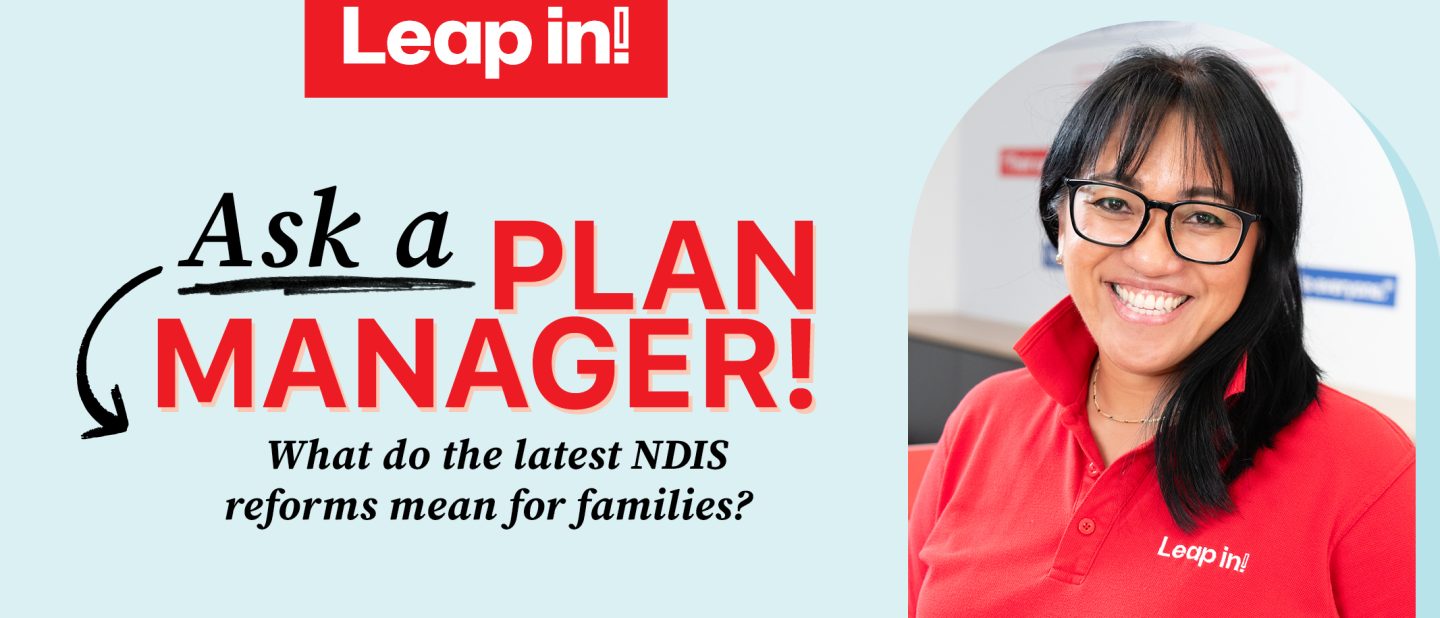
Leap in! plan manager Minell answers some common questions about what is changing, when it may happen and what families can do to prepare.
Key dates for families.
- 27 August 2026: new rules for unscheduled plan reassessments
- October 2026: funding reset begins for some support types and Thriving Kids starts its phased rollout
- February 2027: unspent funds no longer carry over into a renewed plan
- April 2027: new framework planning expected to begin, starting with a small number of people on the NDIS
- October 2027: families with plan management choose a plan manager from a government-approved panel
- January 2028: new NDIS access rules begin
- End of 2030: the move to framework planning is expected to be complete.
Is my child’s NDIS Plan changing now?
For most families, no – you can keep using your child’s funding and supports as usual.
Over time, some of the rules the NDIA uses to make decisions about access, reassessments, plans and funding will change. Because these changes have different start dates, families will not all experience them at the same time.
What is changing with plan reassessments?
Unscheduled reassessments are now only for significant, ongoing changes. Only participants, their nominee or guardian can request one.
From 27 August 2026, the rules for unscheduled plan reassessments have changed. An unscheduled reassessment is when the NDIA looks at a plan before its usual reassessment date because something important has changed.
It is now generally only available when there has been a significant and ongoing change in your child or young person’s needs or circumstances. This could include:
- Finishing school
- Starting work
- Moving out of home
- A major change in the support available from family or carers.
The change may be expected or unexpected. The NDIA has 90 days to decide on your request. If you are not satisfied with its decision, or the 90 days pass without one, you can ask for a review.
What you can do. If a big life change is on the horizon – finishing school, starting work, moving out of home – start gathering evidence now. Recent reports from healthcare or allied health professionals, along with your own notes about your child’s changing needs, put you in a strong position if you need to request a reassessment.
What is changing with social and community participation funding?
From October 2026, some plan allocations are being reduced, but the government has said critical supports like personal care and Specialist Disability Accommodation are not intended to be affected.
From October 2026, the government will reduce the funding allocated in plans for two types of support.
Social, Civic and Community Participation allocations will be reduced by 50%. Capacity Building daily activity allocations will be reduced by 10%.
This applies to the amount allocated in a plan, so the effect will vary depending on how much of that funding your child currently uses. The change is being introduced gradually as plans are reassessed or renewed over 12 months, and it does not affect every part of your child’s NDIS Plan.
The government has said the changes are not intended to affect critical supports, including:
- In-home personal care
- Community nursing
- Home and vehicle modifications
- Personal mobility equipment
- Specialist Disability Accommodation.
Will families be expected to provide more support themselves?
No, the new rules do not add a new expectation on families. They describe more clearly how support from family and carers has always been considered and the NDIA still has to weigh the impact on you.
Informal support, the help provided by family, friends and carers, has always been part of how the NDIA decides what to fund. The new rules describe this more clearly rather than changing it.
What is Thriving Kids, and will my child leave the NDIS?
If your child is already on the NDIS, they will not automatically leave the scheme when Thriving Kids begins.

Thriving Kids is a new early intervention and foundational supports program for children aged eight and under who have developmental delay or are autistic and who have low to moderate support needs. It begins its phased rollout from October 2026 and is expected to be available nationally by January 2028.
Under the transition arrangements, children aged eight and under who joined the NDIS before 1 January 2028 will continue to have their eligibility considered under the previous access rules. Children with higher support needs are expected to continue receiving support through the NDIS.
There is still more to come about Thriving Kids, including how families will access supports and how children may move between foundational supports and the NDIS.
What are the new NDIS Plans I keep hearing about?
From April 2027 the NDIS is expected to start ‘framework planning’, but only for a small number of participants at first and children under 18 are not expected to be in the initial rollout.
Instead of the current budget categories, a plan budget will be informed by an assessment of a person’s support needs, such as their disability support needs, how they manage everyday activities and their stage of life.
The detail of how framework planning will work is still being finalised. Your child or young person’s existing NDIS Plan will stay in place until it is their turn to move across and the NDIA will contact you before this happens.
What else should families know?
A few more changes are coming over the next several years, none of them need action from you right now.
From February 2027, unspent funds will not carry over into a renewed plan. This is different from funding periods within a plan. If your child’s plan has funding periods, unused funding can still carry forward from one period to the next.
Provider registration is also changing over time, particularly for higher-risk supports, though families will still be able to choose unregistered providers for some lower-risk supports.
Plan management is changing too. From October 2027, families with plan management will choose a plan manager from a government-approved panel. There will be a six-month transition and no need to act before then.
Two protections are also worth knowing about:
- You can ask for a decision about your child’s plan to be reviewed, including where an automated system has helped make it
- If the NDIA is considering removing someone from the NDIS, it must make five attempts to contact them first, including at least one in writing, over at least three months.
How to prepare with confidence.
For most families, day-to-day life on the NDIS does not change right now and you have time to prepare well. You can:
- Keep using your child or young person’s NDIS Plan and supports as usual
- Keep clear records of their current needs and supports
- Note any important changes in their daily life or circumstances
- Start gathering evidence early if a major life transition is coming up
- Keep an eye on the Leap in! NDIS Changes page as more detail is confirmed.
What matters most is knowing when a change is likely to affect your child or young person and what to do next.
Leap in! supports families across Australia to understand and manage their young person’s NDIS Plan. If you’re looking for a plan manager, call us on 1300 05 78 78 or email [email protected].
It’s okay to use your child’s funding. Your child’s NDIS funding is there to be used for the supports they need. Using the plan well and getting the supports that help your child or young person is the best outcome for them.
If you are ever unsure whether something is covered, or how to use part of the plan, ask us. Helping you understand and use the plan is exactly what we are here for. You can call Leap in! on 1300 05 78 78.